

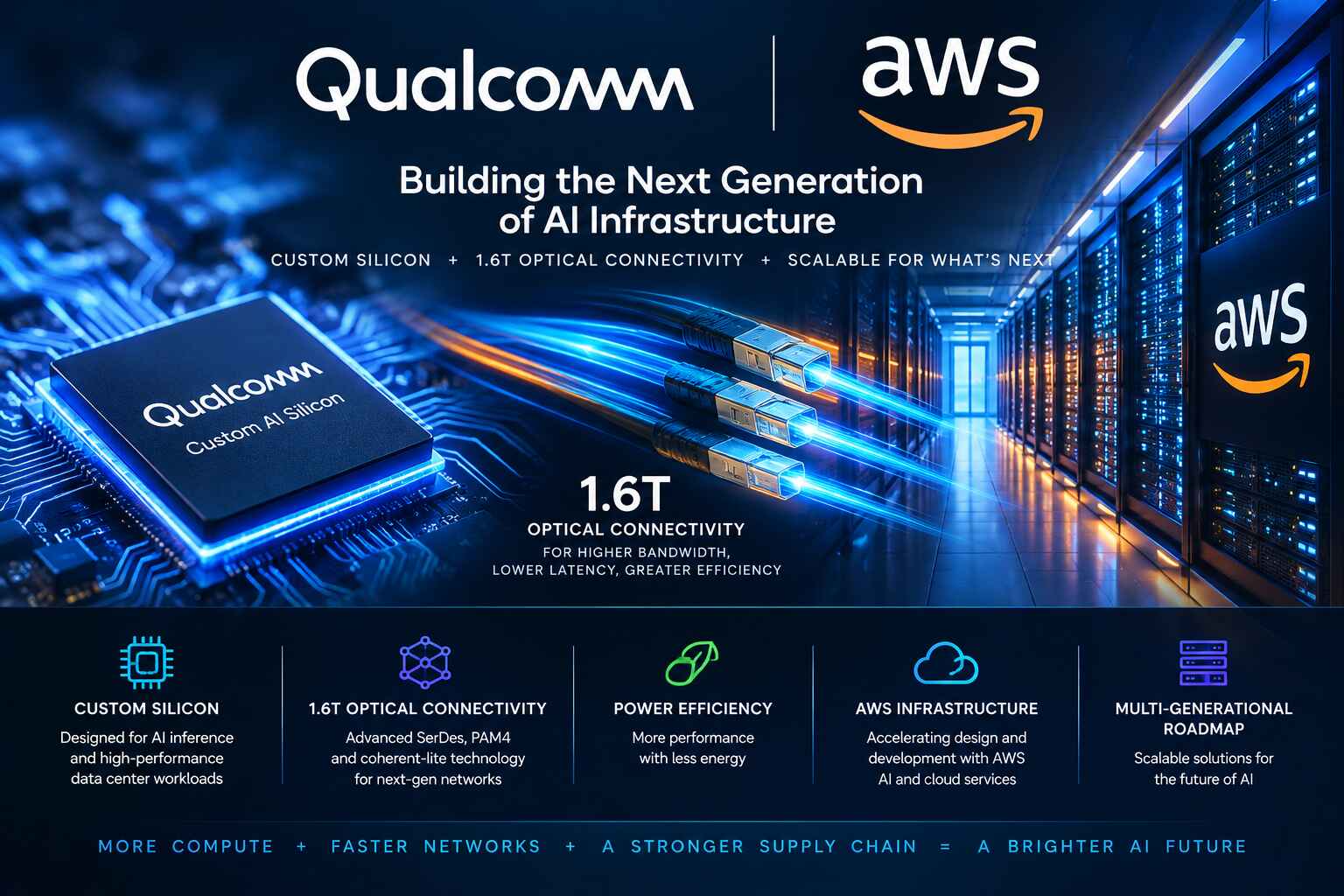





The artificial intelligence infrastructure market is poised to welcome a significant new silicon supplier. Qualcomm, traditionally recognized for its leadership in smartphone processors and wireless communication, is making a definitive entry into large-scale data center computing through a multi-generational partnership with Amazon Web Services (AWS). This collaboration will integrate customized AI processors with high-speed optical networking.
The significance of this development transcends typical hyperscaler agreements. Qualcomm is positioning itself as a key participant in the high-performance computing (HPC) and AI infrastructure ecosystem at a pivotal moment, as the industry actively seeks alternatives to Nvidia’s dominant accelerator platform.
Under the agreement, Qualcomm Technologies and Amazon will co-develop multiple generations of customized silicon tailored for large-scale AI infrastructure, with an initial focus on AI inference. Furthermore, the companies will collaborate on optical connectivity solutions reaching 1.6 terabits per second, while Qualcomm intends to expand its utilization of AWS infrastructure and AI services for electronic design automation (EDA) workloads.
For an HPC industry increasingly constrained not only by compute capacity but also by the challenge of moving massive volumes of data between processors, memory, and storage, this connectivity component may prove as critical as the processor itself.
“As AI demand accelerates, data center infrastructure will require advances in both computing and connectivity to deliver greater performance with more efficiency,” stated Cristiano Amon, President and CEO of Qualcomm Incorporated. “Qualcomm is pleased to work with AWS on customized silicon and connectivity solutions, leveraging our decades of leadership in advanced processing and power-efficient compute to deliver breakthrough performance and enable the next generation of AI infrastructure.”
The objective is clear: Qualcomm is transitioning away from treating the data center as an adjacent market, aiming instead to serve as a foundational element of the silicon and networking architecture that will support the next generation of AI.
A new challenger enters Nvidia’s territory
Nvidia’s extraordinary rise during the AI boom has made its accelerators the de facto standard for much of the world’s AI infrastructure.
The company’s advantage is not simply raw GPU performance. It encompasses GPUs, networking, systems, software, compilers, libraries and the CUDA programming ecosystem. That vertically integrated stack has made Nvidia extraordinarily difficult to displace in traditional AI training and large-scale accelerated computing.
Reuters recently reported that Nvidia’s share of the AI accelerator market remains above 80%, underscoring just how formidable that installed base has become.
Qualcomm is not attempting to replicate Nvidia’s entire platform overnight.
Instead, it is entering through a different architectural door: custom silicon, inference, power efficiency and connectivity.
That distinction matters.
Training frontier AI models requires enormous floating-point compute and memory bandwidth, while inference increasingly involves deploying those models across massive fleets of servers handling billions of queries. The economics of inference are consequently dominated not only by performance, but also by power consumption, memory capacity, networking, and total cost of ownership.
Qualcomm has spent decades optimizing processors for performance per watt. Its data-center strategy seeks to transfer that expertise into large-scale infrastructure.
The company unveiled its Dragonfly data-center roadmap earlier this year, including rack-scale AI inference platforms and a connectivity portfolio supporting 800G and 1.6T networking. Qualcomm says its Dragonfly platforms are designed around high memory capacity, bandwidth, and energy efficiency, with a roadmap extending across multiple generations.
That makes the AWS agreement more than a one-off customer win. It provides Qualcomm with a hyperscale environment in which those architectures can be developed, deployed and iterated.
The 1.6T problem is really a data-movement problem
The headline figure in the connectivity portion of the agreement is 1.6T.
In networking terms, 1.6 terabits per second represents an enormous amount of bandwidth: approximately 200 gigabytes per second of raw binary throughput before accounting for encoding, protocol, and forward-error-correction overhead.
But the important point is not simply the number.
Modern AI clusters are increasingly limited by how quickly data can move between compute elements.
A large AI system may contain thousands, or ultimately hundreds of thousands, of processors. Those processors constantly exchange model parameters, activations, gradients, synchronization data and inference workloads. As accelerator performance increases, the network connecting those accelerators has to scale with it.
Otherwise, increasingly powerful processors spend more time waiting for data.
Qualcomm’s approach is therefore aimed at the broader compute-to-connectivity ratio.
The company says its optical technology will leverage advanced SerDes and optical DSP technologies. Its Dragonfly connectivity portfolio is designed around PAM4 and coherent-lite DSP architectures and supports 800G and 1.6T applications spanning optical modules, active optical cables and active electrical cables. Qualcomm also describes deployments ranging from intra-data-center connections to inter-data-center and campus links of up to 20 kilometers.
The underlying engineering challenge is formidable.
At these speeds, electrical signaling encounters severe channel-loss and signal-integrity problems. Equalization, retiming, modulation, forward-error correction and digital signal processing become critical to maintaining acceptable bit-error rates.
PAM4, four-level pulse-amplitude modulation, allows two bits to be encoded per symbol rather than one, increasing bandwidth without simply doubling the symbol rate. The tradeoff is reduced signal margin and greater sensitivity to noise, making sophisticated DSP increasingly important.
Qualcomm’s existing Dragonfly optical technology illustrates the direction. Its CO400, for example, is a 5-nanometer coherent-lite DSP supporting dual 400G transmission using DP-16QAM for 800G optical links and reaches up to 20 kilometers.
The new AWS collaboration extends that technology trajectory toward 1.6T and future generations.
For HPC architects, this is potentially significant because the future AI supercomputer is becoming less like a collection of isolated servers and more like a single distributed computer.
The network is the backplane.
Qualcomm’s opportunity: Attack the economics, not just the GPU
The most interesting potential impact on Nvidia may therefore come from economics rather than a direct benchmark war.
Nvidia has built an exceptionally powerful ecosystem around accelerated computing. But hyperscalers have another objective: operate enormous AI fleets as efficiently as possible.
Amazon already designs its own AI silicon, including Trainium and Inferentia, precisely because controlling the processor architecture can provide advantages in cost, supply, workload specialization and energy efficiency.
Adding Qualcomm to that ecosystem gives AWS another source of customized compute technology.
And that is important because hyperscalers increasingly do not want their infrastructure strategy to depend on a single merchant accelerator supplier.
Qualcomm’s entry could consequently accelerate a broader shift toward heterogeneous AI supercomputing, systems combining GPUs, custom ASICs, CPUs, high-bandwidth memory and specialized networking rather than relying on one processor architecture for every workload.
Nvidia would remain enormously important, particularly for training and general-purpose accelerated computing. But every successful alternative reduces the industry’s dependence on a single architecture.
That is how technological dominance is normally challenged: not necessarily by one competitor replacing the incumbent, but by the ecosystem acquiring credible alternatives.
The semiconductor shortage changes the equation
There is another reason this partnership arrives at an important moment: advanced semiconductor manufacturing capacity is scarce.
The AI boom has created extraordinary demand for leading-edge process technology. TrendForce reported that TSMC’s 5/4-nanometer and more advanced capacity was expected to remain fully utilized through the end of 2026, with AI processors from Nvidia, AMD and increasingly hyperscaler-designed chips driving demand.
The shortage is not confined to wafers.
AI systems require advanced packaging, high-bandwidth memory, networking components, optical devices, substrates and other specialized components. Broadcom warned earlier this year that TSMC’s capacity was a bottleneck amid surging AI demand and noted that three-to-five-year supply agreements were becoming increasingly common as companies attempted to secure future production.
TSMC itself expects strong multi-year AI-chip demand and is expanding aggressively, including a planned increase in its Arizona investment that would bring its total planned U.S. investment to approximately $265 billion.
That creates an unusual strategic environment.
The AI industry is simultaneously experiencing enormous demand for compute and a shortage of the manufacturing capacity required to produce that compute.
The result is a race not merely to design the fastest chip, but to secure the ability to manufacture it.
From partnership to supply-chain strategy
This is where the Qualcomm-Amazon agreement becomes particularly interesting.
The transaction includes an unusual financial component. Qualcomm issued Amazon a warrant for up to 25 million Qualcomm shares, exercizable at $161.26 per share and expiring in 2036. The shares vest in stages tied to commercial arrangements, binding purchase orders and actual purchases of Qualcomm server-chip products, technology, systems and manufacturing services, with the arrangements linked to as much as $60 billion in Amazon payments.
That structure should not be confused with ordinary equity financing.
The economic mechanism is explicitly connected to future commercial activity: Amazon’s potential equity position grows as the two companies execute the underlying business relationship.
In other words, the partnership itself becomes part of the supply-chain strategy.
That is increasingly important in a semiconductor market where capacity cannot be conjured up when demand suddenly spikes.
The difference between traditional financing and strategic supply-chain alignment is substantial. A financing transaction supplies capital. A long-term commercial relationship can provide something arguably more valuable in a constrained market: visibility into future demand, manufacturing commitments, and product roadmaps.
For Amazon, that can mean another source of custom AI silicon.
For Qualcomm, it provides a major hyperscaler customer capable of supporting multiple generations of products.
For TSMC and the wider semiconductor ecosystem, it represents another large customer seeking advanced manufacturing capacity.
The rise of the custom-silicon supercomputer
The larger story may be the transformation of the supercomputer itself.
For decades, high-performance computing was dominated by relatively standardized CPU architectures, followed increasingly by GPUs. Today’s AI supercomputers are already much more heterogeneous.
The next generation could be even more specialized.
A hyperscale AI system could contain general-purpose CPUs for orchestration, GPUs for certain training workloads, inference ASICs for high-volume model serving, custom accelerators for specific neural-network operations, HBM for high-bandwidth memory and optical networks connecting everything together.
Qualcomm’s strategy fits naturally into that emerging architecture.
Its Dragonfly roadmap combines AI compute with memory and connectivity rather than treating the processor as an isolated component. Qualcomm says its rack-scale AI platforms are targeting inference workloads while its networking technology addresses the growing data-movement requirements between compute nodes.
That is precisely the direction in which hyperscale supercomputing is moving.
Nvidia is still the giant in the room
None of this means Nvidia’s dominance is about to disappear.
Nvidia’s biggest advantage is that its technology is not simply a chip. It is an ecosystem that includes hardware, interconnects, software and developer tools accumulated over years of investment.
Replacing that ecosystem is considerably harder than replacing an accelerator.
Qualcomm therefore has a different battle to fight.
Rather than convincing every AI developer to abandon Nvidia, Qualcomm needs to demonstrate that hyperscale operators can obtain better economics for selected workloads through specialized processors and tightly integrated systems.
AWS is an unusually powerful partner for that experiment.
Amazon controls enormous infrastructure, operates one of the world’s largest cloud platforms and already understands the advantages and challenges of custom silicon.
If Qualcomm can demonstrate competitive inference performance while reducing power consumption or total cost of ownership, the argument becomes less about Qualcomm versus Nvidia and more about whether hyperscalers need Nvidia for every AI workload.
That is a much more consequential question.
Optical networking could become the quiet battleground
There is also a possibility that the networking component becomes one of the most strategically important elements of the announcement.
AI accelerator performance has increased so rapidly that conventional server networking architectures are under increasing pressure.
As clusters scale, network bandwidth and latency directly affect utilization. An accelerator that costs tens of thousands of dollars is economically difficult to justify if it spends significant portions of its operating time waiting for data.
Optical connectivity offers a path toward higher bandwidth and longer reach while reducing some of the electrical limitations associated with copper interconnects.
The transition from 800G toward 1.6T is therefore not merely a specification race.
It is an attempt to keep the communication fabric ahead of processor performance.
Qualcomm’s existing investments in SerDes, DSP, PAM4 and coherent-lite technology give it a technical foundation for that market.
If the company succeeds, it could become valuable to AI infrastructure even in systems where Qualcomm’s processors are not the primary compute engine.
That would give Qualcomm a second route into the supercomputing ecosystem.
AWS becomes the accelerator test bed
The partnership also creates an interesting feedback loop.
Qualcomm will use AWS AI infrastructure, including Amazon Bedrock, for EDA workloads with the goal of reducing chip-design cycles.
That means AWS is simultaneously becoming Qualcomm’s customer, infrastructure provider and development environment.
The implications for chip development are potentially substantial.
Modern processor design requires enormous simulation workloads, verification runs and optimization cycles. Moving more of those workloads onto cloud-based AI infrastructure could allow Qualcomm engineers to iterate more rapidly while applying machine learning to portions of the design process.
Faster design cycles matter enormously in a market where semiconductor generations can become obsolete before manufacturing capacity is even fully available.
A more competitive AI supercomputer market
Qualcomm’s entrance should therefore be viewed less as an attempt to overthrow Nvidia immediately and more as another major piece of evidence that the AI-computing market is fragmenting.
Google has its TPUs.
Amazon has Trainium and Inferentia.
Microsoft has developed custom silicon.
Meta is pursuing custom data-center processors.
AMD continues to challenge Nvidia with its accelerator portfolio.
And now Qualcomm is bringing its own combination of power-efficient compute, custom silicon and high-speed connectivity into the hyperscale infrastructure market.
Qualcomm has also announced a multi-generation data-center CPU relationship with Meta, further establishing its ambitions beyond smartphones.
That matters because competitive pressure does not have to eliminate Nvidia’s market share to change the industry.
If hyperscalers have more credible alternatives, they gain negotiating leverage.
If chip designers have more customers, advanced manufacturing capacity becomes more strategically distributed.
If networking suppliers can deliver higher bandwidth at lower power, accelerator utilization can increase.
And if specialized processors can handle inference more economically, the definition of an AI supercomputer begins to change.
The optimistic HPC outlook
The most encouraging aspect of Qualcomm’s market entry is the expansion of industry alternatives at a time when demand for artificial intelligence significantly outpaces current infrastructure capacity. The trajectory of supercomputing over the next decade will require a multifaceted approach, extending beyond mere processor speed to encompass enhanced compute density, expanded memory bandwidth, accelerated networking, superior power efficiency, advanced packaging, and a more resilient semiconductor supply chain.
By leveraging its substantial semiconductor expertise, Qualcomm is positioning itself to address these challenges directly. While the company is entering a landscape dominated by Nvidia, it is simultaneously entering a market that is actively seeking diversification. The 1.6T optical initiative underscores this strategic shift; future AI supercomputers will be defined not only by accelerator core counts, but by the efficiency of data movement, the system's energy consumption, and the robustness of hardware manufacturing.
Qualcomm’s partnership with Amazon addresses these critical pressures from a distinct architectural perspective. Ultimately, this collaboration signifies a transition toward a new phase of development: as Nvidia established the foundations of the modern AI computing stack, Qualcomm is now positioning itself to influence the next generation of infrastructure. For the field of high-performance computing, this increased competition is a positive development, promising a broader array of specialized architectures, greater focus on operational efficiency, and a renewed industry-wide imperative to synchronize data movement with computational capacity.
